

If you have read our complete guide to Wi-Fi CSI, you know a Wi-Fi link carries a detailed fingerprint of the room it crossed. The obvious next question is whether that fingerprint reaches through a wall. It does. The harder question is what you can honestly do with it, and that is where most viral videos stop being accurate.
01The short answer
Yes, Wi-Fi reaches into neighbouring rooms, and a person moving there changes the CSI you measure. So in the narrow sense of detecting that something moved behind a wall, the answer is a clear yes. In the Hollywood sense of seeing a figure walk around like a thermal camera, the answer is no, not with one small radio. Both of those statements are true at once, and keeping them apart is the whole point of this article.
02Why 2.4 GHz passes through walls
Wi-Fi at 2.4 GHz has a wavelength of about 12 cm. That is long enough to pass through common building materials with only partial loss. Drywall, plaster, wood framing, glass and most furniture are nearly transparent to it, which is exactly why your router covers more than one room in the first place. The signal that reaches your laptop next door has already travelled through at least one wall.
Because the signal makes it through, anything that moves on the far side scatters it differently. That scattering is what shifts the amplitude and phase on your subcarriers. No special mode is needed: the same CSI you captured in our ESP32 capture guide already carries the effect of the next room.
03What a single antenna can and cannot tell you
Here is the honest limit. One antenna measures how the channel changed, summed over every path the signal took. It cannot separate the path that went through the wall and bounced off a person from all the other paths. So you get a strong, usable signal that says "something in the link area moved", and a rough sense of how much, but not a direction, a position or an outline.
We go deeper into exactly why in the limits of single-antenna CSI. For most useful home projects this limit is fine: a presence sensor or an alarm does not need to know where a person stands, only that the room is no longer empty.
04Seeing motion behind a wall
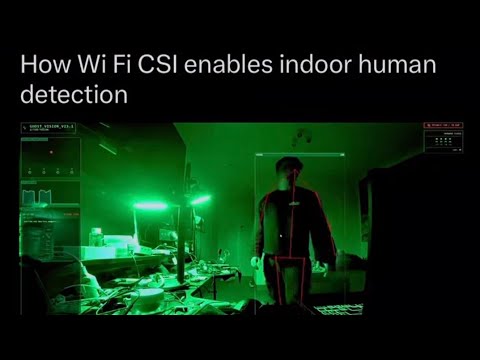
In the hero video at the top, the board and the access point are on one side of an interior wall and a person moves on the other side. The CSI energy clearly lifts out of its resting band each time they move, then settles when they stop. That is through-wall sensing working exactly as the physics predicts: the body changes the paths, the paths change the CSI.
What you will notice is that the signal is coarse. You can tell movement from stillness, and roughly big movement from small, but you cannot read it as a track. That matches what a single link can deliver, and it is still enough to build something genuinely useful in your own home.
05What blocks it, and how far it reaches
Not every wall is friendly. The rule of thumb is simple: materials that reflect or absorb radio cut the range hard, and materials that are transparent to radio barely touch it.
| Material | Effect on Wi-Fi sensing | Through-wall motion? |
|---|---|---|
| Drywall, wood, plaster, glass | Low loss, mostly transparent | Yes, the easy case |
| Brick, stone, tile | Heavy attenuation | Reduced, short range |
| Thick concrete | Very heavy attenuation | Often not practical |
| Metal, foil-backed insulation | Reflects, blocks almost fully | No |
| Water, large tanks, damp walls | Absorbs strongly | Little to none |
With normal indoor power and one interior wall of drywall or wood, a clear body movement is typically detectable a few meters past the wall. Add a second wall, or swap drywall for concrete, and the useful range falls away quickly. These are ranges, not guarantees: your layout, furniture and router placement all matter, so measure your own space rather than trusting a number.
06Why true imaging needs antenna arrays
So how do the research demos that appear to map people through walls work? Not with one radio. They use arrays of many antennas, sometimes dozens, often across wide bandwidth, plus heavy signal processing to separate the many paths and reconstruct where reflections came from. That is a different class of system from a single ESP32, in cost, size and compute.
 Watch · imaging explained
The takeaway is not that imaging is impossible, but that it is a research-grade effort, not something a pocket board does on its own. For a hobbyist or a home builder, the realistic and valuable goal is reliable motion and presence, which one link delivers well.
07Privacy, and keeping this to your own space
Through-wall sensing invites a question we want to answer plainly: this is a tool for your own rooms and your own network, not for watching other people. Pointed at your home it is a camera-free way to know a room is occupied. Pointed at a neighbour it would be both unreliable, because a single link cannot actually image anyone, and a serious violation of their privacy.
Our framing throughout the blog is defensive and educational. Build presence detection you own and control, learn how the physics works, and understand the limits so you are not fooled by overblown claims. If you want to turn this into a working project, the natural next step is our CSI motion alarm, which stays firmly inside one space you control.
08FAQ
Can Wi-Fi really see through walls?
Partly. The 2.4 GHz signal passes through drywall, wood and plaster, so motion in the next room really does change the CSI on a link. But a single antenna only tells you that something moved, not where it is or what it looks like. Seeing in the sense of forming an image needs many antennas and heavy processing.
How far through a wall can Wi-Fi sensing detect motion?
With ordinary indoor power and one interior wall of drywall or wood, a clear body movement is typically detectable a few meters beyond the wall. Range falls quickly with each additional wall, and dense materials like concrete, brick or anything with metal or water cut it down sharply.
What materials block Wi-Fi sensing?
Metal blocks it almost completely, because it reflects the signal. Thick concrete, brick, stone and tile heavily attenuate it, and water, which means large tanks or very damp walls, absorbs it. Drywall, wood, glass and plaster let most of the signal through, which is why interior walls are the easy case.
Can I use Wi-Fi to watch people in another house?
No, and you should not try. Wi-Fi sensing is for your own space and your own network. It gives a coarse motion signal, not a picture of a person, and using radio to monitor people in a home that is not yours is both unreliable and a serious invasion of privacy. Everything here is framed for your own rooms.